
For what?
The Flow Journey can support your team in living integrity, finding individual and collective flow at work and strengthening collaboration and resilience sustainably and in the long term. The change in mindset should not be imposed from above, but from the individual intrinsic motivation of the employees. As we have found, physical exercise is a good way to bring people together and take a step back from purely mental work. Physical activity should be anchored in the business context and become a matter of course in order to make health an important and integral aspect of the company. Employees who do sport together get to know and trust each other better. Physical activity therefore plays a major role in the Flow Journey.
Example
In order to find out in a practical way what it really takes to create a basis of trust in teams, to pick up mentally distressed team members and to resonate with each other, we as a team of authors tested the program using a prototype. Different people in different roles from various companies took part. During the two-month test phase, various tools from this book's treasure trove were first introduced and tested together in weekly online sessions. To incorporate the physical aspect, a yoga lesson was then held with reference to the tools learned. The feedback from the participants encouraged us and showed us that we are on the right track. A similar
Coupling tools and physical exercise is also conceivable with sports such as running, cycling or mountain hiking.
Using the program, we were able to gain practical experience in
team processes not only on a mental level, but to integrate physical movement in order to perceive employees in their entirety and contribute to effective and rapid problem-solving. The participants also became aware of the importance of a safe space and the ability to show our own vulnerability.
What matters
- It is always advisable to first define a clear goal or purpose of the learning journey and then select suitable methods.
- Examples of occasions for a flow journey are: Purpose at work, self-care, challenges in the home office, team collaboration, strengthening the leadership culture.
- It is important to have a person on board who is familiar with the selected tools so that a smooth process can be guaranteed.
- Choose a sport together that is easy to do as a team, e.g. yoga, cycling, running.
- The physical exercise part of the group should be led by a trainer with corporate experience. You can discuss the desired topic with this person beforehand and ask them to address the topic with the physical exercises.
- We used the following tools in the flow journey we tested: Check-in/check-out (verbal and physical), dialog (in pairs and triads), individual purpose at work, journaling. We combined these with yoga exercises that are easy to do when working from home.
- Tools and physical exercise are culture-building practices and can be easily integrated into everyday corporate life.
Step by step
Step 1 - Create space (online or offline): The conditions for a safe space have already been explained in chapter 4.
Step 2 - present the intention and the method: Introduce your employees to the purpose of the Flow Journey as well as the tools and approach.
Step 3 - Apply the tools: As a combination of methods, we recommend first applying one or two tools from this book (approx. 30 min.) and then moving physically together (approx. 60 min.).
Step 4 - Conclude together: In a check-out, you have the opportunity to reflect on the joint flow journey and gather suggestions for a further journey together.
Framework
Duration: approx. 60 - 90 min.
Format: Select tools and movement type in advance
Participants: Team, parts of the team, entire company
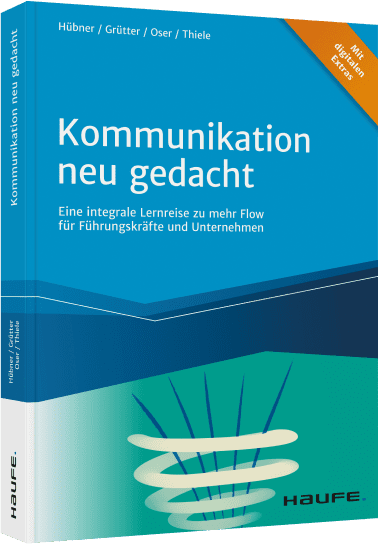
You can find more information on this and other tools for overcoming business challenges with communicative means in the book