
While artificial intelligence is developing inexorably from a trend to a decisive factor for competitiveness, SMEs are still hesitant to actually use it.
High complexity. Lack of resources. Unclear legal framework.
Many managers say: "We don't know where to start."
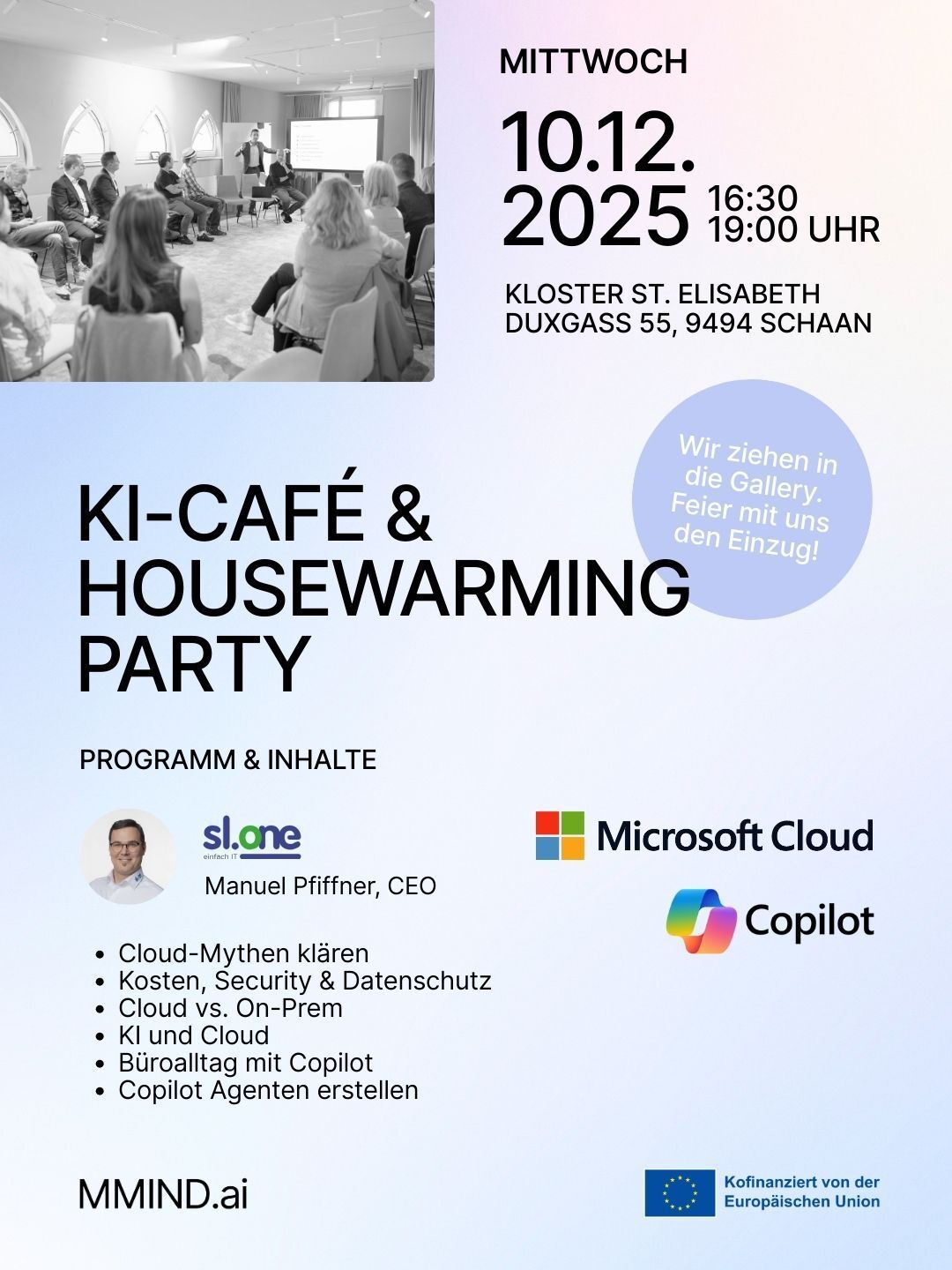
To find clarity, we invite you to the next KI-Café:
Date: Wednesday, December 10, 2025
Time: 16:30-19:00
Location: St. Elisabeth Convent, Duxgass 55, 9494 Schaan
Manuel Pfiffner (CEO, sl.one) shows why using the cloud is a prerequisite for trustworthy AI:
Manuel gets to the heart of the matter:
"For many SMEs, digitalization sounds like a major project. The reality is different thanks to modern cloud platforms. We relieve our customers of the complexity of the infrastructure so that they can concentrate fully on the application. This turns IT into a practical tool that creates measurable efficiency gains in day-to-day work."
The team from mmind.ai shows three immediately usable Microsoft Copilot examples:
→ Analyze data in Excel
→ Summarize email histories
→ Create co-pilot knowledge base
Afterwards: Housewarming in our new gallery in the monastery.
→ Register now (free of charge)
🎙️ You prefer to listen to the newsletter? Here is a short, AI-generated audio summary of this issue:
AI strategy for SMEs: cloud - skills - leadership
Why the cloud is the basis
First: AI models need computing power that local servers cannot provide.
Without the cloud, everything runs slowly or not at all.
Secondly: Security and governance are built into modern cloud platforms.
With local solutions, you have to implement everything yourself.
Thirdly: Your data must be structured and accessible.
Cloud platforms such as Microsoft 365, Google Workspace or Atlassian make this possible.
Without a cloud basis, AI is an experiment.
Cloud-based AI becomes a tool.
Why does AI often not deliver the desired results?
Several executives told us this week: "The new AI models have gotten worse."
"ChatGPT only delivers superficial texts."
"You can't rely on the results."
The cause can be found quickly: A very short prompt. Usually a question. No structure.
Expectation: Perfect answer.
This still worked with ChatGPT 3.5. The models were simple.
It no longer works today.
Not because the models have become worse. But because they are more sophisticated.
One example:
Someone types: "Create strategy for 2025."
The result? Generic fluff. Interchangeable AI talk that fits every company.
Then we reworded it:
"Think hard and weigh up three strategic options for 2025. Consider: market dynamics in the manufacturing industry, our limited resources (20 employees, no sales team), and the cash flow risk in Q3."
The result was unrecognizable.
Suddenly concrete. Usable. Relevant for precisely this company.
The CEO said: "Wait a minute. That's like talking to a real senior consultant."
Framework: Three prompting rules for better results
What made the difference:
Rule 1: Make the model think
"Think hard about it" activates the thinking mode.
The model takes its time. Checks alternatives.
Without this trigger? It provides the most likely answer. Not the best.
Rule 2: Give context that focuses
Not "barrel together".
But "Identify the three most critical risks to our liquidity in Q3. Based on the figures on page 47-52."
The model knows where to look.
Rule 3: Define the role precisely
Not "Act as a consultant".
But "You are our CFO with 15 years of manufacturing experience. You know our cash flow problems. No generic recommendations."
The model cuts out empty phrases.

The new models are like highly qualified experts, luminaries.
They can be brilliant.
But they are not telepathic.
You need a good briefing.
→ Read more:
GPT 5.1 Prompting Guide
Prompting Guide for Gemini 3
Microsoft Model Choice Guide
The practical check: AI in management
Now comes the crucial question: where exactly to start?
Our answer: With the management.
Why?
AI is a management task.
Not because IT can't do it. But because transformation must be exemplified from above.
The organization looks to you. The team imitates what you do.
If you don't use AI in your own sessions, the team won't either.
If you only treat AI as an IT topic, it will remain an IT topic.
But AI is not an IT topic.
AI is a topic for your original tasks as a managing director:
→ Accelerate sessions
→ Driving innovation forward
→ Keeping the organization moving
These are not IT tasks. These are management tasks.
And this is exactly where AI comes in.
The 7 core sessions where AI has the greatest leverage:
1st Weekly 1:1
The Custom GPT prepares every meeting: Open commitments, final decisions, critical topics.
Result: No "What did we discuss last week?"
2nd management team meeting
10-minute KPI review prepared automatically. The management only discusses outliers and strategic decisions.
No longer: "Where do we actually stand?"
3. operating review
The GPT highlights anomalies in production data, stock levels and delivery dates.
The team focuses on measures, not on data procurement.
4th quarter planning (OKRs)
The previous quarter is evaluated automatically. The GL plans the next 3 months.
5. voice-of-customer
Customer feedback from CRM, support tickets and sales calls is bundled.
The GPT identifies patterns. The GL sees the customer's pain points.
6. VR Update
Concise documents created in 15 minutes. The GPT formulates the key messages.
GL supplements, refines and dispatches.
7. all-hands
The "why" of changes is clearly communicated.
The GPT helps to make decisions understandable. Q&As are prepared.
What that looks like in practice:
A Swiss industrial company with 100 employees did just that.
In minute 47 of a management meeting, the head of production asked a question about supply chain bottlenecks.
We fed his question into a custom GPT - trained on the internal processes, supplier contracts and production data.
What would normally have taken a week of analysis by the purchasing department was there immediately.
With three specific options. Including cost comparison.
The management decided at the same meeting.
The CEO later said: "That didn't just save us time. It forced us to think differently."
How it works:
We build a custom GPT with a knowledge base. Relevant documents, processes, decision history.
Optional: connection to Microsoft Copilot, Google Workspace or Atlassian - depending on maturity level and safety requirements.
Mobile use. By voice or input. In the office, home office, on the move.
This is not science fiction. It's available today.
Together with the KMU-HSG, we have developed a guide to digitalization: secure, pragmatic, without technical hurdles.
What you can do in the next few days:
1. come to the KI-Café on December 10
See live how Cloud and Copilot work in everyday SME life.
→ Register now
2. test your prompts
Take a question you asked ChatGPT last week.
Reformulate them with context, role and thought assignment.
Compare the results.
3. download the digitization guide
Together with the KMU-HSG, we have developed a guideline: secure, pragmatic, without technical hurdles.
→ Download here
The cloud is the basis.
Prompting is the tool.
Management is the starting point.
AI works in this order.