
Last week, we presented the results of the Culture Compass 2026 evaluated. 540+ managers from Germany, Austria, Switzerland and the Netherlands.
A pattern runs through the results.
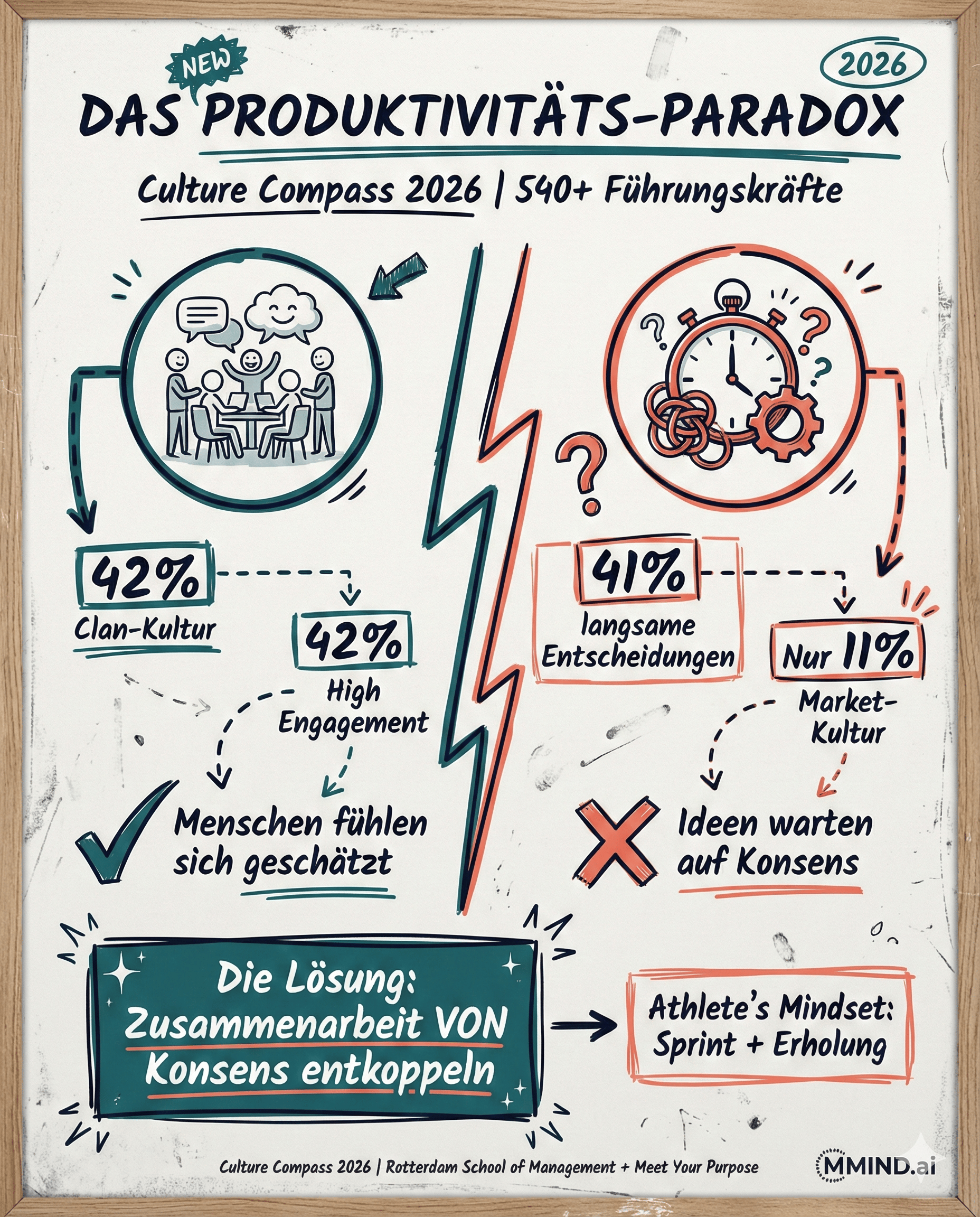
42% of the organizations have a dominant "clan culture". Teamwork, cohesion, family.
At the same time, 41% cite "bureaucratic and slow decisions" as their greatest weakness.
That is not a contradiction.
This is a system that blocks itself.
🎙️ You prefer to listen to the newsletter? Here is a short, AI-generated audio summary of this issue:
Productivity paradox: culture becomes a brake
The problem
European SMEs have built something valuable over the last few decades: Cultures in which people feel valued.
This is reflected in the data. High Employee Engagement is at 42% - the greatest internal strength.
But this is where it gets complicated.
The same organizations struggle with speed. Every idea needs consensus. Every decision goes through loops. Every initiative waits for approval.
That used to be an advantage. Stability. Care. Quality.
But when markets change in months rather than years, this culture becomes an anchor.
Professor Joep Cornelissen from the Rotterdam School of Management puts it in a nutshell: "The challenge for 2026 is not to dismantle people-centered cultures. It's to develop them further - to decouple collaboration from consensus."
That sounds simple. The implementation is not.
Because what we see here has a name: the productivity paradox.
High motivation. Low speed.
The framework
To understand this paradox, it helps to look at an established model: the Competing Values Framework.
Researchers have been using this model to map corporate cultures since the 1980s. It defines four quadrants:
-
Clan - Cooperation, family, loyalty.
-
Adhocracy - Innovation, flexibility, willingness to take risks.
-
Market - Results, competition, performance.
-
Hierarchy - Structure, control, processes.
Most European SMEs move between clan and hierarchy. Stability and cohesion.
This explains why only 11% have a results-oriented market culture. And why only 30% have an innovative adhocracy culture.
A systematic analysis by 2024 shows why this is becoming a problem: "Adhocracy serves as a foundation for cultural change because it enables flexibility and informality."
This does not mean that you have to give up your clan culture.
It means that you need to develop a second skill: the ability to act quickly without losing cohesion.
Here comes the Athlete's Mindset into play.
The practice check: Interval training for organizations
A recent McKinsey article describes how an energy company took an unusual approach to its transformation: Interval training.
The initial situation was typical. Over 100 AI use cases. Fragmented communication. Silos. Technical debt.
The breakthrough came thanks to three principles that stem directly from elite sport.
Principle 1: Clear goals like an athlete
The team identified the three most critical pain points. Not 100 projects. Three.
They then defined measurable success criteria:
-
Time-to-market for digital products
-
Number of AI-trained employees
-
Adoption rate of new solutions
Principle 2: Preparation with the right team
A "Commitment Day" brought business and IT together. Intensive negotiations. In the end: over a quarter of the projects were canceled.
That was not failure. That was focus.
Principle 3: Balance between sprint and recovery
As with interval training, the team alternated between intensive phases and strategic breaks.
The results after four months:
-
Development time halved
-
Technology adoption from 20% to 70%
-
Operational inefficiencies reduced by 10%
The most important insight: The best teams don't just defend or attack. They read the game and switch immediately. Defense to attack in seconds.
Your culture needs the same versatility.
What this means for companies
The Culture Compass 2026 shows a clear path.
Step 1: Optimize processes - separate consensus from decision
Introduce "Disagree and Commit" protocols. The team discusses openly. But when the decision is made, everyone goes along with it.
This preserves psychological safety and still enables speed.
Step 2: Create innovation zones
Not every team has to work the same way. Create protected areas where quick experimentation is possible.
These zones serve as a laboratory for new ways of working.
Step 3: Redefining leadership - from manager to enabler
The bottleneck is not the workforce. It is the management.
The shift: from enforcing rules to enabling results.
What happens next?
On January 20 we present the complete Culture Compass 2026 results live. With us: Professor Joep Cornelissen (Rotterdam School of Management).
We discuss specifically how you can recognize - and resolve - the productivity paradox in your organization.
👉 To the registration (LinkedIn Live): Culture Compass Results Presentation, January 20, 14:00 CET
If you already know that AI business models are your next step, but the culture is holding you back:
Our Macher Sprint in Schaan brings both together. Speed and substance. In three intensive days, you will develop a concrete prototype - with the team that will actually implement it.
👉 More about the Macher Sprint