
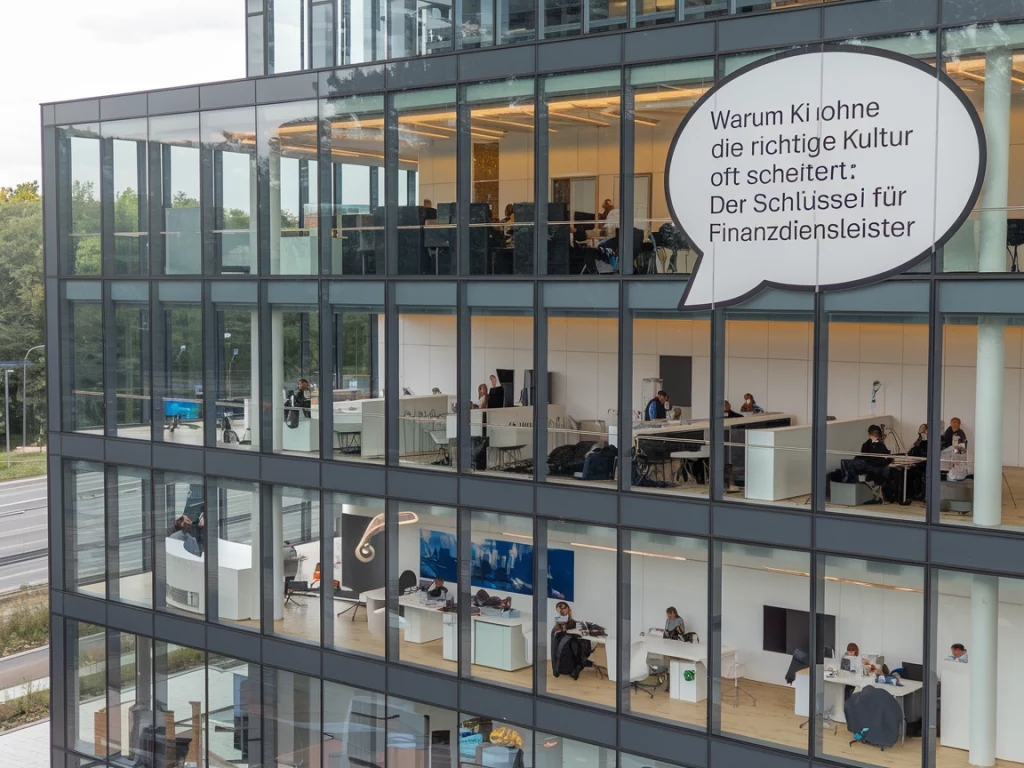
70 % of digital transformation projects fail.
Why? Not because AI is flawed or the digital tools don't work. The real problem lies in something that many managers underestimate: the corporate culture.
The financial sector is facing major challenges: Many providers are struggling with regulatory requirements, traditional hierarchies and risk aversion. Added to this are rising customer expectations.
These points show: AI is an important technological driver. However, the problem also lies in the "soft" factors, which often do not develop as quickly as the technologies.
Growth culture" solution approach
Imagine a financial services company where teams work on improvements every day, collaborate seamlessly across departments and implement technological innovations quickly.
Employees are empowered to take smart risks, try out new ideas and continuously improve.
Such a Growth culture (Growth Culture) makes it possible, for example:
✅ Routine tasks by AI to automate and thus gain time for innovation.
✅ The personalized, smooth processes that customers expect today.
✅ One step ahead of the competition as innovations are implemented on a daily basis.
Successful examples from the financial sector
🏦 BBVA (Spain): By integrating AI into digital services, BBVA was able to reduce customer churn by 25 % and significantly increase satisfaction.
🌟 Monzo (England): The fintech relies on AI in customer-facing areas, such as fraud detection, to build trust and win new customers.
🔄 ING (Netherlands): Automated compliance reports with AI tools help to save time and increase the proportion of value-adding tasks in the teams.
These success stories illustrate a simple truth: Digital solutions and AI make faster progress in companies with a growth culture.
What approach has proven successful in advancing the corporate culture?
Start with these 5 concrete steps:
1️⃣ Leading the way in the management team: As a manager, show curiosity, adaptability and a willingness to learn. Your behavior sets the tone for your entire team.
2️⃣ Celebrate small successes: Reward and appreciate innovative approaches - even if they are not immediately successful. This creates momentum and encourages further ideas.
3️⃣ Dismantle silos: Promote transparency and collaboration between your teams. Trust, open communication and the critical thinking that goes with it are essential for using AI effectively.
4️⃣ Empowering employees with AI: Go beyond pure training. Help your team to find individual use cases for how AI can facilitate and enrich their work.
5️⃣ Listen and implement together: Actively involve your team in the design of AI processes. Your input ensures acceptance and practical solutions.
Concrete steps for the financial sector
To promote a growth culture and open up the organization to new digital solutions, it is advisable to create concrete application examples, such as
📊 Using AI to simplify compliance reporting and free up resources for innovation.
💡 Supporting customer analyses with AI and enable your team to implement the findings directly.
🔄 Simplify processesto encourage experimentation and iterative improvements.
🌟 Collect real-time feedbackto continuously refine strategies.
Are you ready to turn your bank into a growth powerhouse?
✅ Start with one of the steps above.
✅ Carry out regular pulse checks with the team to find out how the company culture is doing and how it is developing over time.
✅ Commit to creating an environment in which growth and innovation thrive.