AI & Innovation
Kimi K3: What Longer Context and Parallel Agents Mean for SMEs
Kimi K3 is an unusually large model with native vision and a one-million-token context window. Its practical value will depend on the working system around it.
20 July 2026
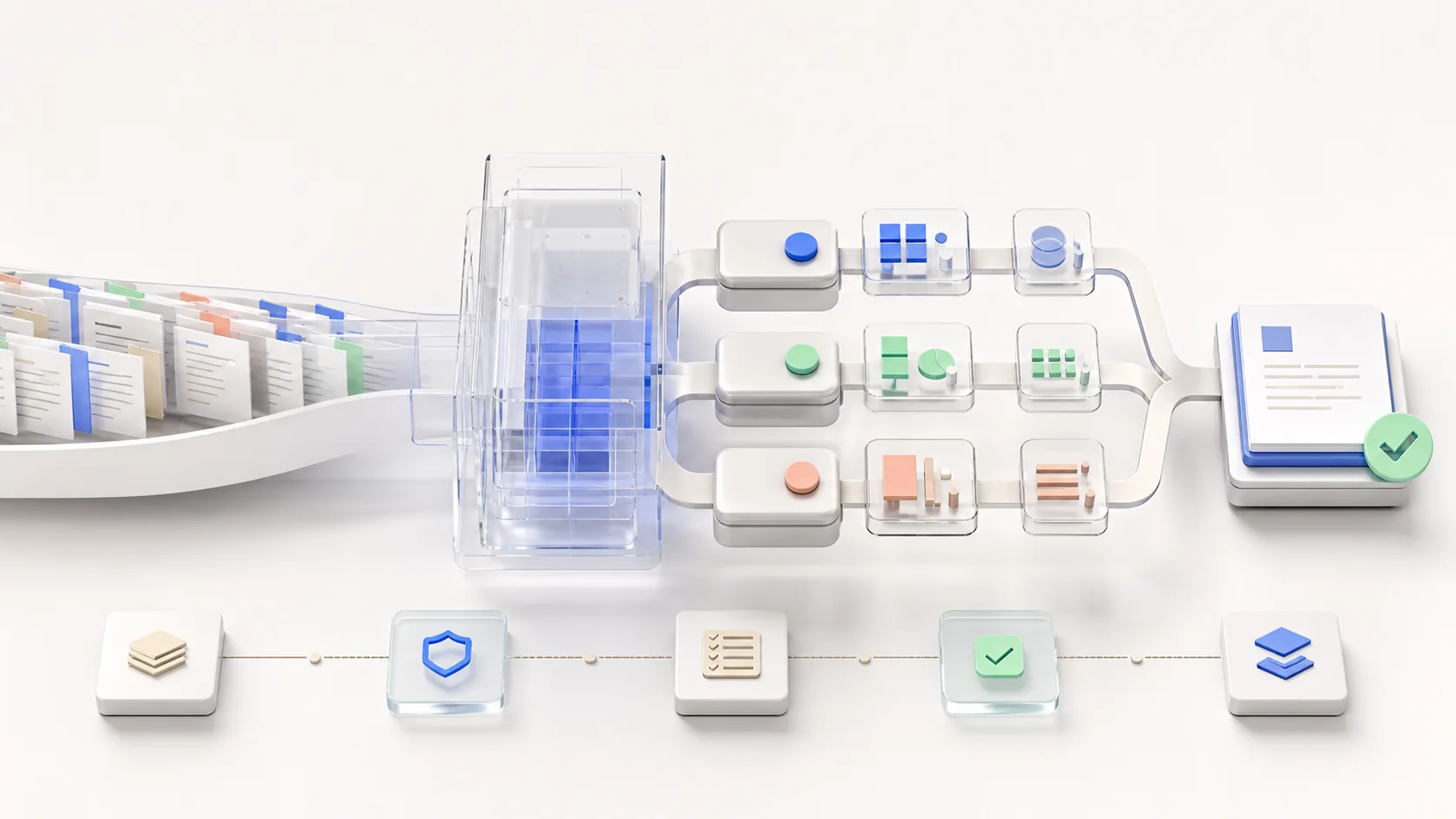
Kimi K3 has produced the usual release-week noise. I wanted to know what was underneath it, so I went back to the primary sources.
I read Moonshot AI's technical announcement and API documentation, then watched founder and CEO Yang Zhilin explain how his team thinks about scaling AI agents. The result is an eight-page implementation guide and a smaller recommendation for SMEs.
Download the eight-page Kimi K3 Agentic Engineering Guide (PDF)
The useful question is not whether K3 wins a benchmark. It is what this model could change inside a working system.
What is confirmed so far
Moonshot describes K3 as a 2.8-trillion-parameter model with native visual understanding and a context window of 1,048,576 tokens. Its apps and API are live. The current API documentation lists tool calling, structured output, vision input, automatic context caching and three reasoning-effort settings: low, high and max.
The release is not complete. Moonshot says the full model weights will be published by 27 July 2026, together with a more detailed technical report. Many launch benchmarks still come from Moonshot's own evaluations and agent harnesses. They are interesting signals, not independent proof.
That distinction matters. A model can be available for testing before every architectural claim and benchmark result can be reproduced.
The engineering thesis behind the release
Yang's GTC session is more useful than the benchmark tables. He describes three directions for scaling agentic systems:
- improve token efficiency, so the model learns more from a finite amount of high-quality data
- extend context, so an agent can carry more evidence and sustain a longer task
- increase the number of agents, so genuinely independent subtasks can run in parallel
This is not a recipe for adding more agents to every process. It is a way to think about capacity. Better prior knowledge, a longer operating memory and parallel execution can each remove a different bottleneck.
For an SME, that leads to three practical tests.
1. Test company knowledge before rebuilding retrieval
A one-million-token context window lets an agent work with much more company material in one pass. A team could test a complete policy set, a large project archive, a product catalogue or a substantial codebase without first splitting every document into a complex retrieval pipeline.
That does not make retrieval obsolete. It changes the order of work.
Before building infrastructure around yesterday's context limits, compare two approaches on one real task: native long context and your current retrieval setup. Measure answer quality, omitted evidence, latency and cost.
Capacity is not governance. The system still needs:
- approved sources and clear permissions
- version ownership for important documents
- a record of which evidence entered a decision
- human review where the consequence of error is material
Putting more documents into a prompt does not tell the model which version is authoritative.
2. Engineer the complete agent loop
Moonshot's API guidance contains a detail that is easy to miss: after a tool call, the complete assistant message should be returned in the next request, together with the matching tool result. Trimming the history down to a neat text summary can make the trajectory unstable.
For a production test, I would keep the design equally explicit:
- retain the full tool-call history required by the model
- give the agent two or three well-described tools
- define what the agent may decide and when it must stop
- use visual evidence in the same loop when screenshots, documents or interfaces matter
- increase reasoning effort only for the calls that need it
Parallel agents are useful when the work can genuinely be divided. Researching independent markets, checking separate contracts or analysing different data sources may qualify. Five agents editing the same short document probably do not.
The orchestrator also needs a completion rule. Starting ten subtasks is not success if four never return a usable result.
3. Measure completed work, not agent activity
Agent dashboards make it easy to count calls, tokens and spawned workers. None of those numbers tells you whether the business task improved.
For one pilot, track four things:
- Was the expected artefact produced?
- How often did a person need to correct it?
- What did the complete run cost?
- How much review or preparation time did it save?
This makes comparisons possible. Run the same workflow with K3 and the model already in your stack. Keep the sources, tools, output definition and reviewer constant. A larger context window is useful only if it improves the finished work enough to justify the operating cost.
A deliberately small pilot
Choose one recurring workflow with a visible bottleneck. Give the agent approved sources, two or three tools, a defined output and a named decision owner.
Run it several times. Keep the failures. Compare it with your current model. Then decide whether longer context, native vision or parallel agents solved a real constraint.
K3 may prove important. The lesson is already clear: model capability becomes useful only when it sits inside a well-designed working system.
Status note
This Note was checked against Moonshot AI's technical announcement and API documentation, and Yang Zhilin's NVIDIA GTC 2026 session, on 20 July 2026. Moonshot schedules the full weights and technical report for 27 July. I will recheck the guide after publication.