
In focus · Prototype in development
Decision Ground
A workspace for business decisions.
Decision Ground is the workspace I am developing for business owners and their teams: to investigate an open question, weigh the options and learn from what happens next.
Prototype in development. The next step is to test a complete decision cycle with a small number of teams. Scope, terms and any paid pilot would be agreed separately.
What needs deciding?
A new service. An investment. A supplier change. A process that needs to improve. These questions rarely come with complete information. The useful work is to make the evidence, assumptions and trade-offs clear enough to take the next step.
For example: should we use AI to prepare customer quotations? A useful answer needs approved data, alternatives, someone responsible for checking the work and a way to judge the result. A limited trial may be the right next step.
01
Deep Research for open questions
Investigate the question with relevant sources, competing explanations and visible gaps. The planned output is a research dossier that can become part of a decision record.
02
A second brain that keeps learning
Keep personal and shared knowledge up to date as new evidence and results arrive. The system proposes changes to the team wiki; people review them before they become shared knowledge.
03
A decision barometer, with reasons
Explore how an option fits your goals, how strong the evidence is and how easily you could reverse it. Jev by TypeSafe is the planned decision-AI component. Its judgements need testing; a score is not a probability of business success.
04
A record that stays useful
Keep the options, objections, decision and next review together. AI can prepare the work; a named person remains responsible for the decision. Results should improve the next discussion.
Use the AI workspace that suits you.
The intended architecture is open: access through compatible AI applications using MCP, including Mistral Vibe, ChatGPT, Claude, Microsoft Copilot through Copilot Studio, and local open models with Ollama. Each connection depends on the application's capabilities, plan and permissions. These integrations are planned, not available features today.
German hosting is a design requirement. The location of the app and the processing of its data must be checked separately. Jev and other external services will only be suitable for explicitly approved data routes. A strictly German processing mode must leave them disabled unless that route is verified. A local MacBook demonstration is also planned.
The pitch, slide by slide
14 slides · Prototype in development. Technical implementation notes are omitted from this public edition.
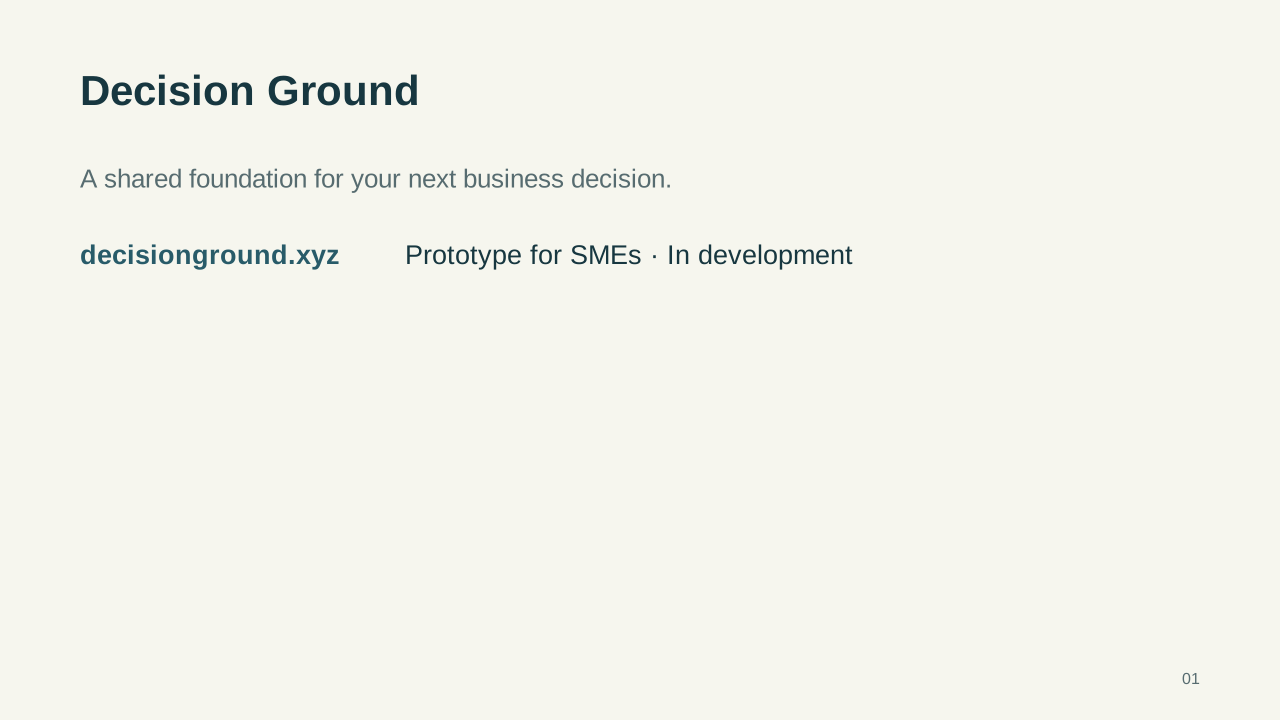
Read the slide text
1. Decision Ground A shared foundation for your next business decision. decisionground.xyz Prototype for SMEs · In development
2. The next important question Many documents. Different perspectives. A decision to make. The question Should we use AI to prepare customer quotations? The discussion What do we know? What are we missing? Who decides? How will we later know whether it helped?
3. A workspace for business decisions AI prepares the shared record. The team works from the same version. Prepare A clear question. Relevant sources. Options and open assumptions. Decide Questions and objections. A named person confirms the specific version. Follow up Next steps and a review. What we learn stays useful for the next case.
4. Deep Research for open questions An important question receives research you can examine. Question Subquestions, scope and budget are visible before the research starts. Investigation Approved internal sources and public evidence. Counterarguments stay in the record. Result A dossier with references, contradictions and open questions becomes part of the record.
5. A second brain for the owner and team Knowledge grows with new evidence and results and stays current. Personal Your goals and notes stay private until you deliberately share them. Shared The team wiki learns from new evidence and reviewed results. Current Old assumptions are flagged. Sources, dates and changes stay visible.
6. Experience improves the next decision Learning comes from results that have been reviewed. First decision We expect less effort in preparing customer quotations. Review We compare processing time, corrections and actual use. Next case A confirmed lesson improves the team wiki and the next template.
7. The decision record in daily work Example: a proposal to automate customer quotations. The options Keep the current process, run a limited trial or roll out more widely. The open question Which data may enter the trial, and who checks the results? The proposal A limited pilot with an owner, a stopping criterion and a review date. Illustrative content. Sources, assumptions and AI proposals carry different labels.
8. Objections strengthen a decision A team member can improve the proposal before it becomes binding. The objection The trial makes sense. But we cannot use these customer data for it. The process Record the objection. Revise the proposal. Confirm the resolution. An unresolved serious objection blocks consent.
9. The decision barometer Ask a question. Gain orientation. Check the reasoning. Goal contribution Likely helpful: based on a confirmed goal and explicit criteria. Evidence Still incomplete: sources, counterevidence and open questions. Reversibility Easy to reverse: a limited trial with an exit route. Jev provides graded judgements. Missing knowledge stays open. No invented success rate.
10. Autonomy with clear responsibility The software prepares the work and keeps the process moving. Within agreed limits Organise approved sources. Draft research and briefs. Flag changed assumptions. Show reviews that are due. With human approval Change team knowledge. Confirm an objection is resolved. Approve a specific decision version, budget or external action. Every action remains bound to permissions, data approval and the current version.
11. Access through your preferred AI application Compatible AI applications and MCP form an open product architecture. Mistral Vibe Clarify questions and prepare decision briefs. ChatGPT and Claude Continue using your preferred AI workspace. Microsoft Copilot Connect through a Copilot Studio agent. Ollama and others Use open models on your own computer. Planned demo: compare quotations with local AI on a MacBook. Connections depend on the application, plan and permissions.
12. German hosting with verifiable data routes The app, knowledge and decision records are intended to stay in Germany. Strict German mode Storage and content processing only through verified German services. Jev stays disabled until a suitable German data route is demonstrated. German-hosted mode Storage in Germany with transparently agreed external processing. Jev and external Mistral Chat only for explicitly approved data. Hosting location and AI processing are verified separately.
13. The first evidence comes from a real case A paid Decision Sprint tests usefulness and willingness to pay. An owner and team An important question, a clear owner and approved sources. A complete cycle Research, proposal, objections, decision and an agreed review. A second decision The team reuses confirmed knowledge and decides whether to continue. Pilot proposal: three teams. Scope, price and impact still need validation.
14. What needs deciding? Let us build a shared foundation. Decision Ground decisionground.xyz
What’s on your mind as a business owner?
In 30 minutes, we can look at what is on your mind, what information is missing and what to test first. No preparation is required.
Book a conversation · 30 minutesBooking opens the EDIH.li Unternehmergespräch with Hartmut Hübner via Google Meet. Relevant EDIH support and eligibility are clarified separately. Decision Ground is Hartmut's product initiative; booking is not a product purchase or an EDIH endorsement.