AI & Innovation
RheinTalent: Purpose matching as a conversation, not a verdict
RheinTalent connects a cross-border labour market through anonymous profiles, confirmed skills, and purpose matching. AI prepares the conversation. It does not decide who belongs together.
24 July 2026
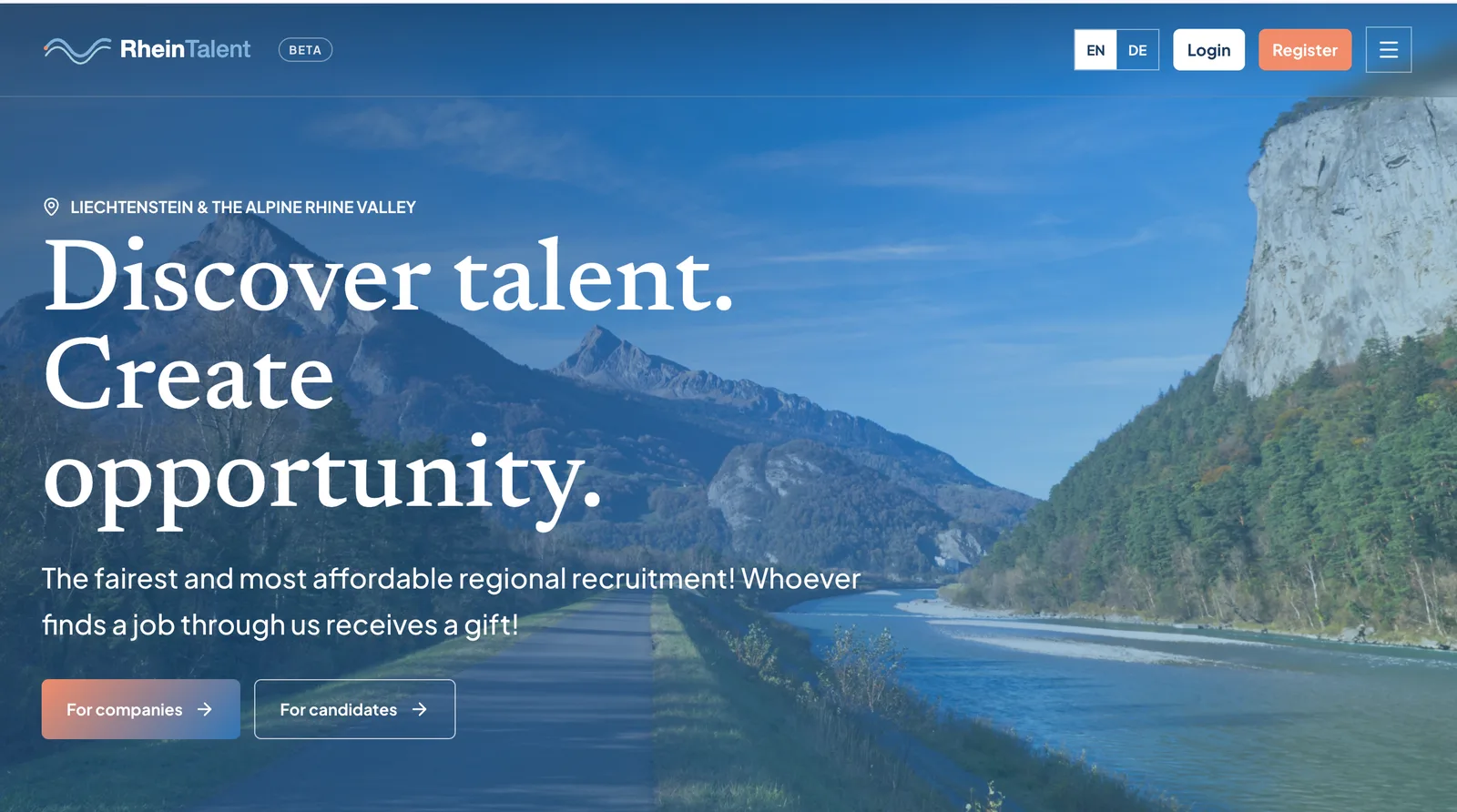
At the end of 2024, 57.4 per cent of the people working in Liechtenstein commuted from abroad. The labour market does not stop at the national border. It connects Liechtenstein with the Alpine Rhine Valley, Eastern Switzerland, and Vorarlberg.
That is where RheinTalent begins. The platform aims to bring regional talent and companies together without reducing people too early to a CV, job title, or AI ranking.
The important question is not whether AI is used in recruitment. It is what job the AI is given, what information it may see, and who makes the final decision.
A regional question became a product
The first idea emerged in summer 2024. It returned to the table in the KMU-Tools mastermind group in 2026. On 26 March, Alexander Jeeves, Manuel Pfiffner, Zeno John, and I turned the sketch into a concrete project.
Four perspectives shaped the work: markets and financial services, infrastructure, rapid software prototyping, and AI architecture and product development. RheinTalent is now intended to become a joint venture between Jeeves Group and MMIND.ai. Manuel helped develop the idea in the mastermind group but will not hold a stake in the company.
That distinction matters. RheinTalent did not grow out of a finished recruitment method. It is a regional product experiment with explicit assumptions, limits, and open questions.
Why another matching system is not enough
The current research exposes a clear tension. Skills-based recruitment sounds sensible. In practice, a new label does not change a selection process on its own. If a company continues to use the same keyword filters, rankings, and approval routines, the result is likely to remain much the same.
The scientific evidence on LLMs in recruitment is also uneven. A scoping review by Tripathi and colleagues maps research published between 2018 and 2026. Many applications concern the early stages of recruitment. Robust tests of safeguards and long-term outcomes are far less common.
Two other studies make the boundary particularly clear. Vaishampayan and colleagues found that LLM assessments should not simply be treated as a replacement for human judgement. Wilson and colleagues showed experimentally that biased AI recommendations can influence human decisions even when a person formally remains in charge.
A human click at the end is therefore not enough. The AI may already have shaped the decision, from the wording of the role description to the order in which people are suggested.
Purpose matching as reflection
RheinTalent deliberately keeps skills and purpose separate.
On the talent side, an AI-assisted interview works through four questions inspired by Ikigai:
- What kind of work gives me energy?
- What am I good at?
- What do I want to contribute to?
- What can an organisation meaningfully employ and pay me to do?
On the company side, a second interview helps describe the organisation's why, how, what, and the values visible in daily work. Both sides receive a purpose statement that they can edit.
Only then does the system compare the confirmed statements. It should explain where a connection exists and where uncertainty remains. Skills continue to be a separate signal.
This is not a psychometric diagnosis. Ikigai and the Golden Circle are frameworks for reflection. They prove neither suitability nor cultural fit, and they do not predict professional success.
The real risk is similarity
Purpose matching can deepen a conversation. It can also reward conformity.
If a company mainly looks for its current self-image, a digitally amplified similarity bias can develop quickly. Different perspectives may then appear to be a weak match even though they may be exactly what innovation needs.
RheinTalent therefore follows five product rules:
- The original answers remain available for review.
- Both sides can edit the generated statement.
- Skills and purpose remain separate signals.
- A similarity needs an understandable explanation.
- Purpose must not automatically filter or rank people.
Visible human involvement is not a regulatory shortcut either. Under the EU AI Act, a system's risk classification depends on its intended purpose. Systems used to analyse or filter applications or evaluate candidates may qualify as high-risk applications. The precise use case therefore requires a separate legal assessment.
Candidates control the first contact
RheinTalent starts with an anonymous talent profile. Names and contact details remain protected. The person decides whether a company may make contact and can exclude particular employers.
This does not eliminate discrimination. Identity and biographical context become visible at the latest during a personal conversation. The anonymous start changes the sequence, however: skills, motivation, and working context come first. Identity follows with consent.
The AI prepares a more precise first conversation. The talent and the company decide whether that conversation takes place and what happens next.
What the pilot can actually measure
RheinTalent is not evidence that purpose matching leads to better hiring. We do not yet have the usage and outcome data required to make that claim.
The first test is smaller:
- Does the person confirm the structured skills and statements?
- Is the explanation of the connection understandable?
- Do both sides agree to a conversation?
- Which information proves useful or incorrect during that conversation?
These responses can improve the next product increment. A large purpose score cannot.
RheinTalent is in beta
At the AI Café in Schaan on 20 August 2026, people from HR, legal, compliance, and fiduciary services examined RheinTalent and the limits of AI-supported selection. One particularly useful idea was to turn a static profile into more of a guided conversation.
Explore RheinTalent as a company or candidate
RheinTalent does not yet promise a better hire. The pilot is designed to show whether more explainable context can support a better first conversation. The technology prepares. Trust and decisions remain human.