AI & Innovation
AI in compliance: from manual bottleneck to controlled workflow
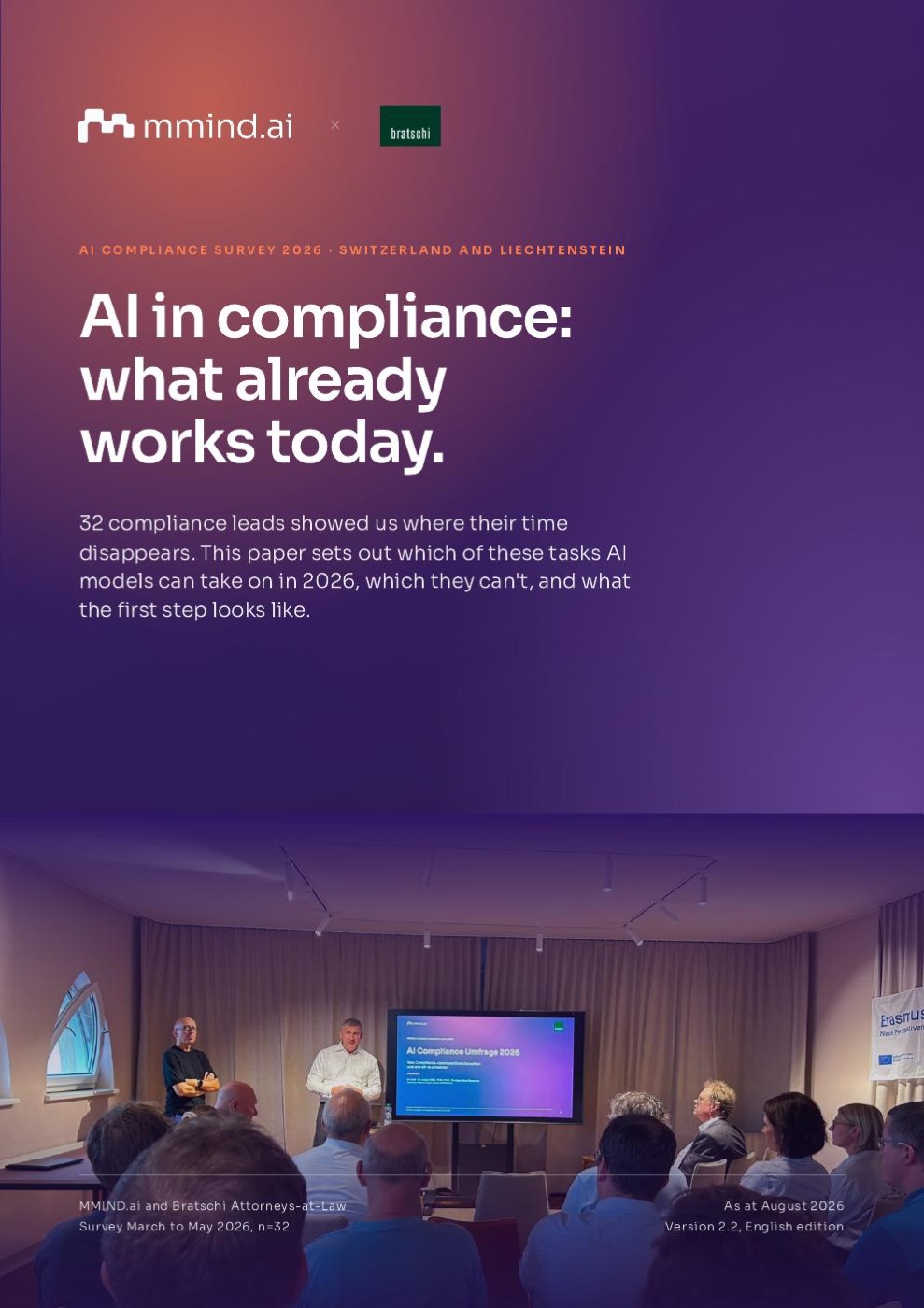
The AI Compliance Survey 2026 shows where valuable specialist time is tied up in research, document retrieval, and reporting. The new whitepaper explains how that work can become a bounded and reviewable AI workflow.
16 August 2026
Compliance work is rarely slowed down by one major decision. Time disappears across many small steps: checking regulatory sources, comparing PDFs, assigning changes, locating evidence, updating spreadsheets, and preparing reports.
This is where AI can become useful. Not as an automated legal authority, but as a controlled working layer between approved sources and the qualified person responsible for the decision.
The AI Compliance Survey 2026, developed by MMIND.ai and Bratschi, examines this starting point in Switzerland and Liechtenstein. The survey is exploratory rather than representative, but it reveals a consistent set of practical bottlenecks.
What the survey makes visible
- 81 per cent still track regulatory change through manual research.
- Half of the participating organisations spend at least 20 hours per week on manual compliance tasks.
- 84 per cent work with unstructured documents.
- 91 per cent want support with reporting.
- 75 per cent prefer in-house or hybrid data processing.
These figures are not a market model. They help frame the useful technical question: which recurring information task can a system prepare without taking over professional judgement?
Four useful first workflows
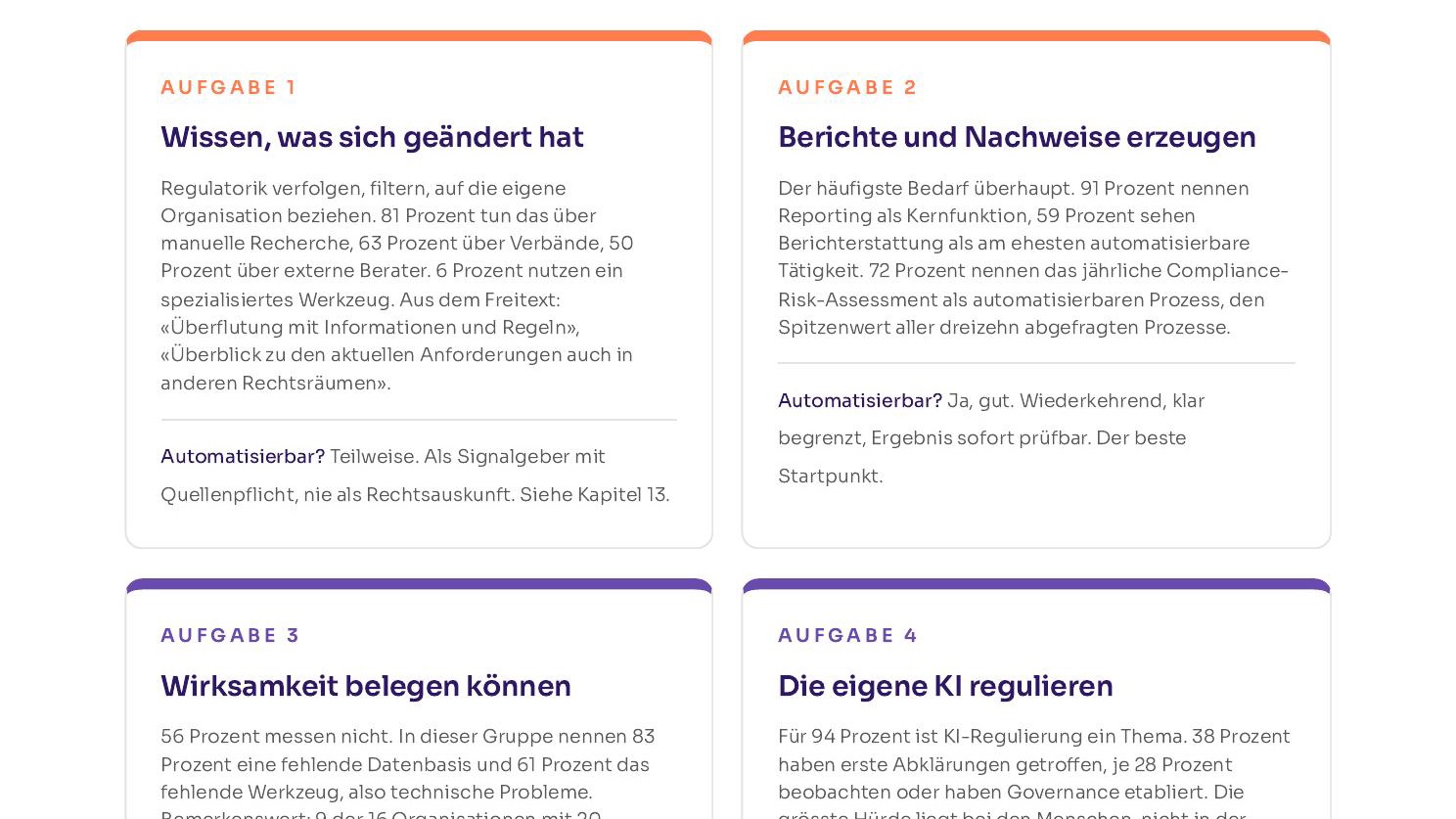
Regulatory monitoring: A system watches defined sources, identifies changes, and compares them with the existing position. A qualified person assesses relevance and consequences.
Reporting: Approved documents are prepared in a defined reporting format. Missing evidence and uncertain statements remain visible.
Evidence mapping: Requirements are connected to available evidence. The system marks gaps instead of hiding them behind plausible language.
Recurring document processes: Folder-based workflows in legal, fiduciary, or sustainability work can prepare tables, letters, and review material. Approval remains with the named professional.
Governance belongs inside the system
Compliance material may contain employment data, internal investigations, client information, or legally privileged content. A useful workflow therefore needs more than a capable model:
- defined and approved sources
- role-based permissions
- visible citations and audit records
- explicit uncertainty and missing evidence
- a clear handover to a qualified person
- measurement of errors, rework, cost, and review time saved
The preference for in-house or hybrid processing is not a minor technical detail. Architecture, provider selection, and data classification need to match the actual protection requirement.
A first test can fit into half a day
A useful pilot does not start with a platform decision. It starts with a process:
- define one recurring task and the expected result
- classify the data and approved sources
- mark permitted AI steps and human decision points
- test with a bounded document set
- compare quality, time, errors, and rework
A half-day working session is often enough to build a first controlled workflow. The team can then use real results to decide whether to stop, improve, or develop it for production.
The whitepaper contains the full survey findings, prioritised starting processes, a tool review framework, and the main governance questions. Use the form below and the personal download link will be delivered by email after double opt-in.
AI Compliance Whitepaper 2026
Get the full whitepaper by email.
Confirm your email address and we will send you the English whitepaper with the complete survey findings, starting workflows, and governance checklist. You will also receive the AI Field Notes newsletter.