AI & Innovation
What shared AI learning can produce: a year of Erasmus+ MMIND
A recruitment prototype, a compliance whitepaper and business models from young founders: what our Erasmus+ project produced and which materials are now available for others to use.
14 October 2026

1 / 3
How does a business question become a project that a team can actually take forward? That question ran through our year of Erasmus+ MMIND. A regional skills shortage led to RheinTalent.li. In compliance, it led to a whitepaper with prioritised applications and guidance on responsible AI use. In Munich, young founders developed business models and initial prototypes from their ideas.
For me, these results show what shared AI learning can achieve: people contribute their expertise, test assumptions and make a next step tangible. AI helps with research, structure and drafts. Discussion with others helps establish whether the result holds up.
Two mastermind groups, two concrete results
The “Future of Work” group started with the region's need for skilled workers. Across eight working sessions, it developed target customers, a value proposition and a business model for AI-supported recruitment. This produced the RheinTalent.li prototype.
A prototype makes an idea open to discussion. People can examine a process, ask questions and test an assumption against a tangible interface. It does not yet demonstrate successful job placements. That distinction matters when a learning project is to become a viable service.
The second group, “AI & Compliance”, explored a different starting point in five sessions: how can professionals use AI for research, document retrieval and reporting while retaining responsibility for their decisions? An exploratory survey of 32 compliance professionals provided practical questions. The whitepaper prioritises application areas, describes examples and sets out governance recommendations. The survey is not representative; the whitepaper does not replace legal review.
Both groups presented their results at the AI Café in Schaan on 20 August. People outside the regular groups could see the work and ask questions.
Munich: testing ideas together
On 11 and 12 June, 18 young founders in five teams worked on their ventures in cooperation with LMU Munich. Target customers, value propositions, business models and prioritised assumptions formed the basis for further development. The exchange continued at the AI Café on 16 June.
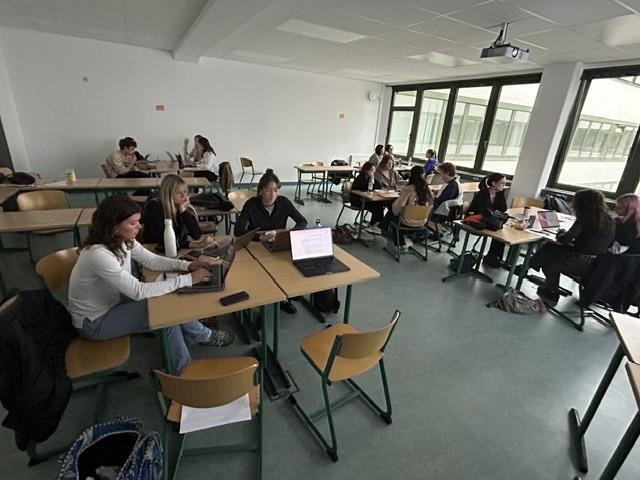
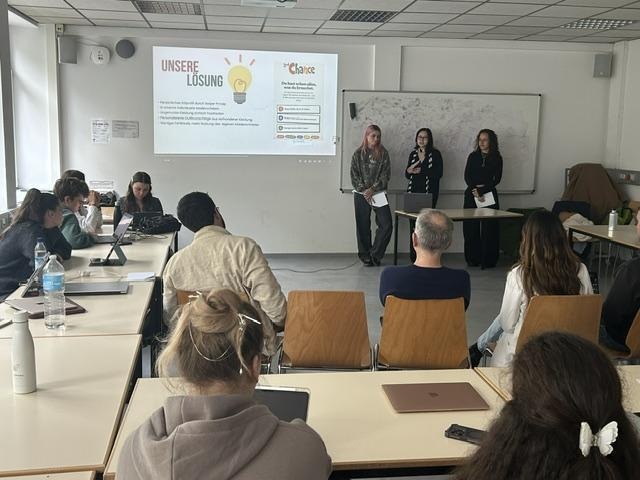
The photographs show two parts of this process: focused work in small groups and the presentation of a proposed solution. A pitch requires a team to explain clearly who an offer is for and which problem it addresses. Questions from others reveal what still needs work.
The documented results of the five teams make this development process accessible to other founders too.
From learning to a tool of your own
At the final workshop with dockyard.ventures in Bolzano on 27 August, we brought the same approach to recurring business processes. The team developed four reusable AI skills and two clickable prototypes, for a company website and time tracking. I have described the AI workshop's process and results separately.
Across the project, the strategy work package delivered eleven training sessions involving 44 adults. Ten case studies document how different businesses and teams worked with the methods. The mastermind groups, further training and open exchanges at the AI Cafés complemented this work.
Repeated work on a question of their own proved particularly valuable. A team could bring a draft, examine it with others and show at the next meeting what had changed.
The results are available for others to build on
We have brought together eight public result packages on the MMIND project page (German landing page, with English result PDFs). They cover the project overview, the Knowledge Hub and SPARK, tools, training formats, strategy work, the two mastermind results and the Munich Startup Sprint.
MMIND.space remains the central entry point for this knowledge. SPARK contains five learning modules; the toolkit collection contains five toolkits with 15 assistants. The materials also explain access, prerequisites and limits of use. Existing methods and external tools retain their respective rights and terms.
If you want to organise an AI learning process, begin with a real question from your own business. A small team, a draft that can be tested and an agreed date for the next working session are a useful starting point. The result packages can help you prepare the process.
Project and funding
MMIND: Mastering AI with Training, Tools & Peer Learning ran from 1 September 2025 to 31 August 2026. Its partners were Hübner Management GmbH, datalucid gmbh, Vegaluna GmbH, dockyard.ventures GmbH and Factor Product GmbH, from Liechtenstein, Austria and Germany.
The project was co-funded by the European Union through Erasmus+. Project number: 2025-1-LI01-KA220-ADU-000357904. This article presents the results after the project's conclusion.

Co-funded by the European Union. Views and opinions expressed are those of the authors only and do not necessarily reflect those of the European Union or AIBA. Neither the European Union nor AIBA can be held responsible for them.